Access Path
Access Path Introduction
What are Access Paths?
Section titled “What are Access Paths?”Access paths, also known as controlled traffic lanes or tramlines, are permanent, designated tracks in a field that are used exclusively by farm machinery. Instead of driving randomly across the entire field, tractors, sprayers, and other equipment repeatedly follow these same, narrow paths, year after year.
Why Are They Used?
Section titled “Why Are They Used?”The main reason for using access paths is to prevent soil compaction. When heavy machinery drives over a field, it compresses the soil, which reduces pore space, hinders water infiltration, and restricts root growth. By confining all machinery traffic to these specific lanes, the vast majority of the field's soil remains untouched and healthy, leading to better crop yields.
Their Role in Precision Agriculture
Section titled “Their Role in Precision Agriculture”Access paths are a fundamental part of Controlled Traffic Farming (CTF), a key strategy in precision agriculture. GNSS-based auto-steering systems and RTK positioning allow farmers to navigate their machinery with sub-inch accuracy. This ensures that every pass stays precisely within the established access paths. This practice leads to several benefits:
- Increased Yield: By eliminating compaction in up to 80% of the field, crop health and growth potential are maximized.
- Resource Efficiency: Fuel consumption is reduced, and the targeted application of seeds, fertilizers, and pesticides becomes more effective because the non-compacted soil holds moisture and nutrients better.
- Sustainability: Reduced soil erosion and improved soil structure contribute to a more sustainable farming system.
In essence, access paths combine physical field management with digital precision technology to optimize soil health and agricultural productivity.
Access path in AgNav
Section titled “Access path in AgNav”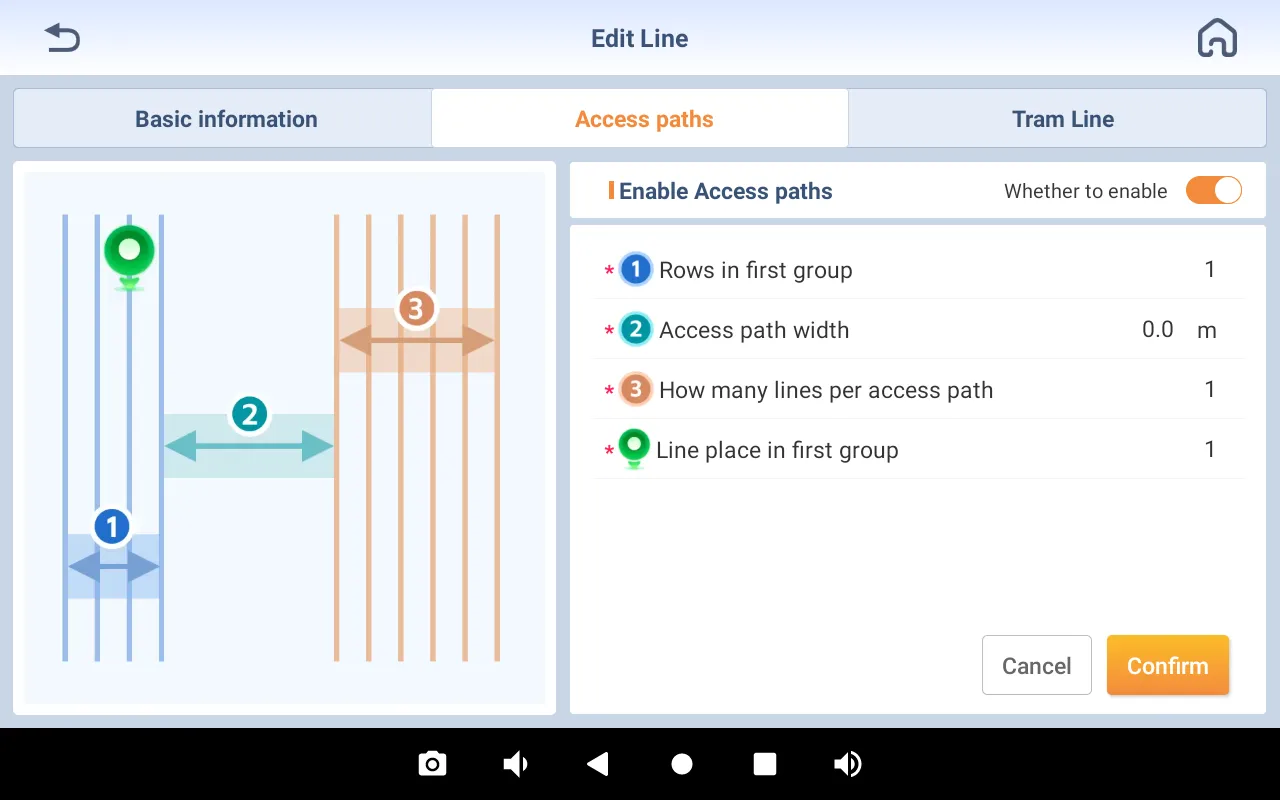
| Parameter | Definition |
|---|---|
| Rows in first group | Number of guidelines in the first group of guidelines |
| Access path width | Desired width of the access path |
| How many lines per access path | Number of guidelines between two access paths |
| Line place in first group | The sequence of AB-point line in the first group |